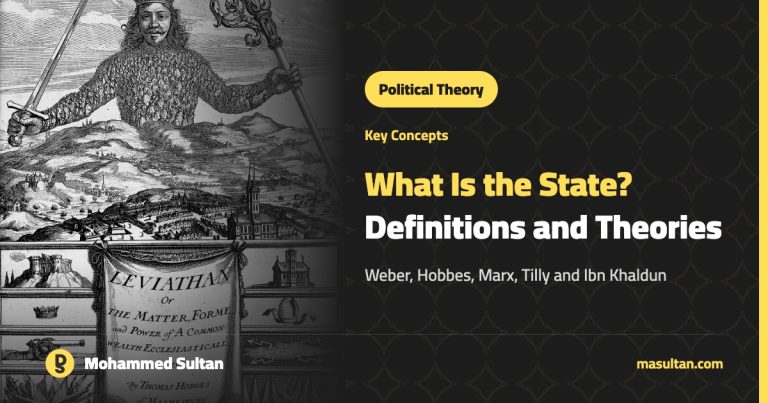
Few books in the history of political thought have a more famous image or a darker reputation than Thomas Hobbes’s Leviathan. Its frontispiece shows a giant crowned figure whose body is made of countless tiny people, towering over a peaceful landscape with a sword in one hand and a bishop’s crozier in the other. The message is clear: peace is possible only when individuals unite under a single sovereign power. This article explains who Hobbes was, what Leviathan argues, and why it still matters for anyone trying to understand the modern state.
Hobbes’s life and times
Thomas Hobbes was born on 5 April 1588 in Westport, near Malmesbury in England, in the year the Spanish Armada threatened the country. In a later verse autobiography he joked that his mother gave birth to twins: himself and fear. He studied at Magdalen Hall, Oxford, and spent most of his life as a tutor and secretary to the Cavendish family, the Earls of Devonshire. This position gave him access to libraries, travel and the leading scientists of Europe, including Galileo, whom he visited in Italy, and the circle of Marin Mersenne in Paris.
Hobbes’s political writings were shaped by the crisis of his age. As tensions between King Charles I and Parliament grew in the 1640s, he left for France, fearing for his safety. There he wrote De Cive (1642) and then Leviathan, published in London in 1651, two years after the execution of the king. He returned to England soon afterwards and lived until 4 December 1679, dying at Hardwick Hall at the age of 91.
The method: politics as a science
Hobbes admired geometry and the new mechanical science. He wanted to build political philosophy in the same way: start from clear definitions and simple principles about human nature, then deduce conclusions step by step. Leviathan therefore begins not with kings or laws but with sensation, imagination, speech and the passions. Human beings, for Hobbes, are bodies in motion driven by desire and aversion, constantly seeking what they think will preserve and benefit them.
The state of nature
In chapter 13 of Leviathan, Hobbes imagines people living without any common power to keep them in awe. Because individuals are roughly equal in strength and cunning, anyone can kill anyone else. Because they compete for scarce goods, distrust one another and seek glory, conflict is constant. The result is a “war of every man against every man.” In such a condition there is no industry, agriculture, navigation, arts or letters, and, in Hobbes’s most quoted phrase, the life of man is “solitary, poor, nasty, brutish, and short.”
Hobbes did not claim that all of humanity had literally lived this way at one moment in history. The state of nature is a thought experiment that shows what life would be like if political authority collapsed, something his generation had seen in the civil war.
Laws of nature and the social contract
Reason, however, points the way out. Hobbes identifies a series of “laws of nature,” rational rules for self-preservation. The first is to seek peace when it can be had; the second is to be willing to lay down one’s unlimited right to all things, if others do the same. People therefore make a covenant with one another: each agrees to transfer his right of governing himself to one person or assembly, on condition that everyone else does likewise. This act creates the commonwealth, the “great Leviathan,” which Hobbes also calls a “mortal god.”
| Concept | Hobbes’s meaning |
|---|---|
| State of nature | Life without a common power: equality, insecurity and permanent fear |
| Right of nature | The liberty each person has to use his power to preserve his own life |
| Laws of nature | Rules of reason that forbid self-destruction and recommend peace |
| Covenant | The mutual agreement that creates the sovereign |
| Sovereign | The person or assembly that bears the authority of all and keeps the peace |
The powers of the sovereign
Hobbes’s sovereign has very wide powers: to make and enforce laws, to judge disputes, to make war and peace, to appoint officials and even to control which doctrines are taught, because false opinions can lead to rebellion. Subjects may not overthrow the sovereign on the grounds that he governs badly, since any return to the state of nature would be worse than the harshest government.
Yet Hobbes also set limits. Because people enter the commonwealth to preserve their lives, no one can be obliged to kill or injure himself, and a subject may resist those who come to kill him. And the obligation of subjects lasts only as long as the sovereign is able to protect them. These points show that Hobbes’s absolutism rests on a modern, individualist foundation: the state exists to secure the safety of its members.
Legacy and criticism
Hobbes’s ideas shocked many contemporaries, especially churchmen who considered his views on religion and human nature dangerous. Later thinkers responded to him directly. John Locke accepted the idea of a social contract but argued that government must protect natural rights and may be resisted if it violates them. Jean-Jacques Rousseau criticised Hobbes for projecting the vices of civilised society onto natural man. Realist theorists of international relations, meanwhile, have seen the relations between states as a kind of Hobbesian state of nature, since there is no world sovereign above them.
- He helped create the modern idea of the state as an artificial person created by its members.
- He made consent and security the basis of political obligation.
- He raised questions about order and liberty that remain central today.
Conclusion
Hobbes wrote Leviathan in a time of civil war, and its central question is still urgent: what makes peaceful political life possible? His answer, a powerful sovereign created by the agreement of all, is one many readers reject, yet even his critics have had to argue on the ground he defined. To go further, read our guide What Is the State?, our article on the state and civil society, and browse the political theory section. Arabic readers can consult our article on Thomas Hobbes.
References
- Thomas Hobbes, Leviathan (1651), ed. Richard Tuck, Cambridge: Cambridge University Press, 1996.
- A. P. Martinich, Hobbes: A Biography, Cambridge: Cambridge University Press, 1999.
- Noel Malcolm, Aspects of Hobbes, Oxford: Oxford University Press, 2002.
- Quentin Skinner, Reason and Rhetoric in the Philosophy of Hobbes, Cambridge: Cambridge University Press, 1996.
- Richard Tuck, Hobbes: A Very Short Introduction, Oxford: Oxford University Press, 2002.