We pay its taxes, carry its passports, obey its laws and argue about its policies every day, yet few of us stop to ask what the state actually is. Is it the government? The country? The people? Political scientists have offered many answers, and each answer reveals a different way of seeing power, authority and community. This article explains the main definitions of the state, the elements that make it up, and the leading theories of where it comes from and what it does.
State, government, nation: clearing up the terms
In everyday language “state”, “government” and “country” are used interchangeably, but political science distinguishes them carefully:
- The state is the permanent political institution that holds sovereign authority over a territory: its laws, courts, bureaucracy, army and police.
- The government is the group of people who direct the state at a given moment. Governments change through elections or other means; the state continues.
- The nation is a cultural and psychological community of people who feel they share a common identity, language or history. A nation may exist without a state, and a state may include several nations.
Weber’s classic definition
In his 1919 lecture Politics as a Vocation, the German sociologist Max Weber defined the state as “a human community that (successfully) claims the monopoly of the legitimate use of physical force within a given territory.” Three elements stand out. First, force: the state is ultimately backed by the ability to coerce. Second, legitimacy: its use of force is accepted as rightful, which distinguishes it from a gang. Third, territory: its authority is bounded in space. Weber also explained that legitimacy can rest on tradition, on the charisma of a leader, or on legal-rational rules, a theme we explore in our article on Weber’s types of authority.
The legal definition
International law uses a more formal test. The Montevideo Convention of 1933 lists four criteria that are still widely cited:
| Criterion | Meaning |
|---|---|
| Permanent population | A community of people living on the territory |
| Defined territory | A reasonably stable area, even if some borders are disputed |
| Government | An effective authority exercising control |
| Capacity to enter into relations | The ability to conduct relations with other states |
Behind these criteria lies the principle of sovereignty, often traced to the Peace of Westphalia in 1648, which consolidated a European order of territorial states that recognise no higher authority within their borders.
Where does the state come from?
1. Social contract theories
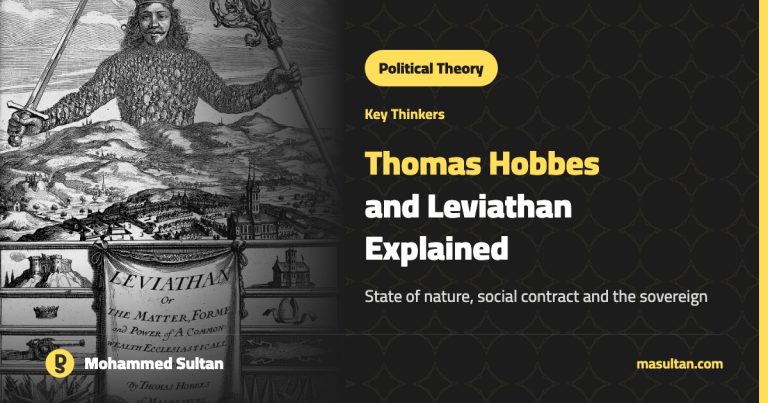
For Thomas Hobbes, life without a common power would be a “war of all against all”, so individuals agree to transfer their natural freedom to a sovereign in exchange for security. John Locke argued that people form governments to protect their natural rights to life, liberty and property, and may resist a government that violates them. Jean-Jacques Rousseau grounded legitimate authority in the “general will” of the people. For all three, the state is justified by consent.
2. The Marxist view
Karl Marx and Friedrich Engels saw the state not as a neutral arbiter but as an instrument through which the dominant class maintains its position. In The Origin of the Family, Private Property and the State (1884), Engels argued that the state arose when society split into classes with irreconcilable interests.
3. Pluralist and elite theories
Pluralists describe the state as an arena in which many groups (businesses, unions, associations) compete for influence, with power widely dispersed. Elite theorists such as Gaetano Mosca and Vilfredo Pareto replied that in every society a small organised minority governs the majority.
4. War and state-building
The historical sociologist Charles Tilly famously summarised European history with the phrase “war made the state, and the state made war.” To fight wars, rulers needed armies; to pay for armies, they built tax systems and bureaucracies; and these institutions became the modern state.
5. An earlier insight: Ibn Khaldun
Centuries before these European theories, the fourteenth-century scholar Ibn Khaldun explained in his Muqaddimah how dynasties (dawla) rise on the strength of group solidarity (ʿaṣabiyya), reach their peak, and decline as luxury erodes that solidarity. His cyclical theory remains one of the most original accounts of political power.
What does the state do?
Whatever its origins, the modern state typically performs several core functions:
- Maintaining order and security, internally and externally.
- Making and enforcing laws, and settling disputes through courts.
- Raising revenue through taxation.
- Providing public goods such as infrastructure, education and health.
- Representing the political community in international relations.
How far the state should go beyond these basic tasks is one of the central debates of political theory, dividing liberals, socialists and conservatives.
Conclusion
The state is at once a set of institutions, a legal person in international law and an idea that commands loyalty. Weber’s definition highlights force and legitimacy; legal definitions emphasise territory and recognition; and the great theories ask why the state exists and whom it serves. Understanding these perspectives is the first step to thinking clearly about politics. To go further, read our article on the state and civil society, our introduction to political science, or browse the political theory section. Arabic readers can also consult our Arabic article on the concept of the state.
References
- Max Weber, “Politics as a Vocation” (1919), in H. H. Gerth and C. Wright Mills (eds.), From Max Weber: Essays in Sociology, New York: Oxford University Press, 1946.
- Thomas Hobbes, Leviathan (1651), ed. Richard Tuck, Cambridge: Cambridge University Press, 1996.
- Charles Tilly, Coercion, Capital, and European States, AD 990–1990, Oxford: Blackwell, 1990.
- Ibn Khaldun, The Muqaddimah: An Introduction to History, trans. Franz Rosenthal, Princeton: Princeton University Press, 1958.
- Andrew Heywood, Politics, 5th ed., London: Red Globe Press, 2019.